Embroidery Basics - 10 Beginner Stitches

Embroidery Basics
(before you stitch)
Hoop: snug, not drum-tight.
Needle: embroidery/crewel size 5–9
Thread: 6-strand cotton floss. Use 2 strands for outlines, 1 for fine detail, 3–6 for bold lines and fills.
Start & finish: tie a tiny knot to start, or leave a 2 in tail and weave under the back of your stitches to secure at the end. Keep tension gentle so fabric doesn’t pucker.
Tip for steps below: “Up at A” = bring needle up through fabric; “Down at B” - push needle down through.
Straight Stitch - The foundation stitch

Use for: simple lines, petals, rays, grass, or background texture
Steps:

Bring the needle up through the fabric at point A — this is your starting point
Decide how long you want your stitch to be, then insert the needle down at point B
Pull the thread through until it lays flat (not tight)
Repeat, varying length and direction as needed for your design.
Running Stitch
(dashed line)

Use for: borders, basting, simple outlines
Steps:

Up at A
Down at B (a short distance away)
Up at C, keeping spaces even
Repeat “small stitch, small gap”
Keep it neat: aim for stitch = gap length for an even dash pattern.
Backstitch
(solid outline)

Use for: crisp letters and outlines.

Steps:
Up at A, down at B
Up at C
Go back down into A
Repeat: up one space ahead, down into the end of the last stitch.
Tip: tiny stitches make smooth curves.
Whipped Back Stitch
(twisted outline)

Use for: decorative outlines, vines, lettering, borders
Steps:
Stitch a regular backstitch line first.

Bring a new thread up at the start of the line.
Slide the needle under each backstitch (don’t pierce fabric).
Stem Stitch
(fishbone stitch)

Use for: leaves, petals, and filled shapes
Steps:

Mark a center vein line
Up at top center, down slightly to one side
Up just below the top on the opposite side, cross the center line
Keep alternating sides, overlapping slightly down the center
Finish at the base of the leaf
Chain Stitch
(linked loops)

Use for: chunky outlines, vines.
Steps:
Up at A, Down at A again, but don’t pull through—leave a small loop on top.

Up at B (a stitch length away), catch the loop with the needle tip,
then pull to snug.
Repeat to make a chain of loops.
To end, make a tiny locking stitch: down outside the last loop. Chain Stitch
(linked loops)
Lazy Daisy
(detached chain petals)

This a Variation of the Chain Stitch.
Use for: flowers, leaves, teardrops.

Steps:
Up at A (petal base)
Down at A again, leaving a loop
Up at B (petal tip), catch the loop and pull to shape
Lock with a tiny stitch just beyond B.
Repeat around a center point for a daisy.
Shape tip: longer B makes longer petals.
Satin Stitch
Use for: solid shapes like leaves, letters.


Steps:
Up at one edge, down across the shape—straight, parallel to each other
Pack stitches side-by-side to cover fabric fully
Keep tension even so the surface stays smooth
Pro tip: for wider shapes, use long & short (below) instead to avoid sagging.
French Knot (tiny dots)
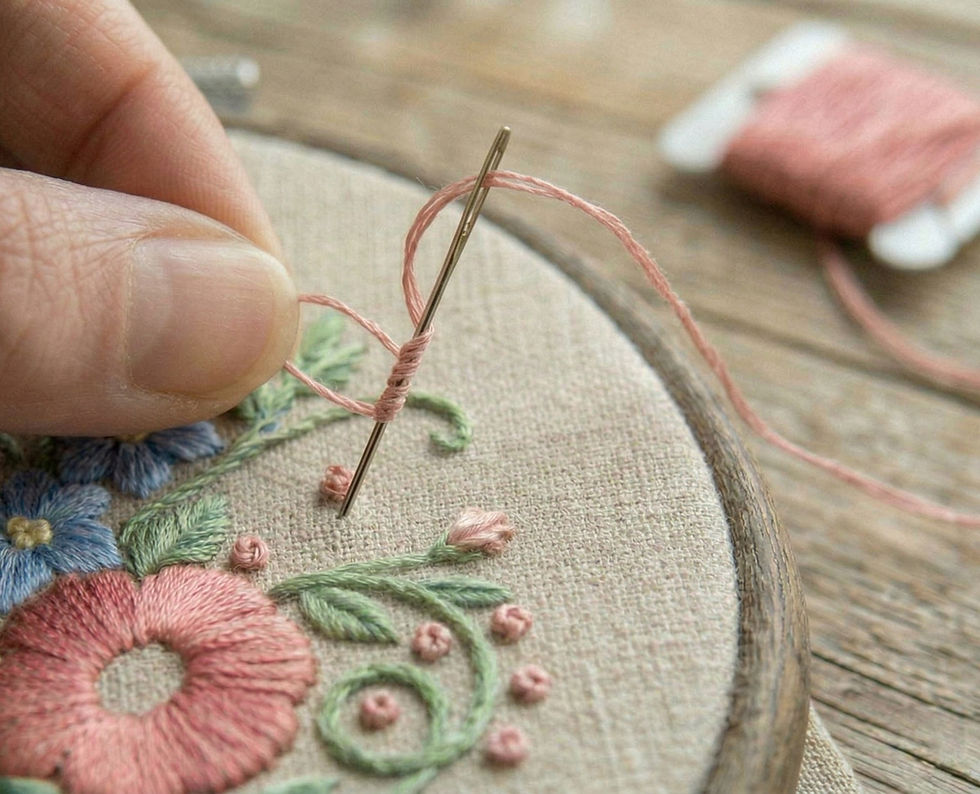
Use for: flower centers, eyes, dotted texture

Steps:
Up at A and Wrap thread around needle 1–3 times
(more wraps = bigger knot).
Hold wraps snug with your non-needle hand.
Insert needle down at B, a hair’s breadth from A
Keep tension on the thread as you pull through to seat the knot
Fix: if knots sink through, use more wraps or fewer strands.
Couching Stitch
(laid thread)

Use for: bold outlines, lettering, and decorative borders
Steps:
Lay a long thread flat on the fabric surface

With another thread, make tiny stitches across it at intervals to hold it down
Continue securing along the entire length
End by taking both threads to the back to secure
Tip: use contrasting colors for a decorative look, or matching thread for subtle texture.
Quick Troubleshooting
Puckering fabric: loosen hoop or stitch tension.
Fraying thread: use shorter lengths (18 in max) or fewer strands.
Jagged curves: take shorter stitches on tight bends.
Messy backs: weave tails under 3–4 stitches; trim, don’t knot bulky tails.


Comments